Mobile Barber: Sanitary Requirements Explained
A client calls: "Will you come and cut my hair at home before the wedding?" You say "sure", pack the clippers into a backpack and set off.
A client calls: "Will you come and cut my hair at home before the wedding?" You say "sure", pack the clippers into a backpack and set off. Except — where will you disinfect the tools? How will you wash your hands if there's no soap in the client's bathroom? And in the event of an inspection or a cut, do you have anything at all on paper? A mobile barber means the same hygiene as in the premises — just without the walls that help you.
Working at the client's, in a hotel or in a care home is legal and increasingly popular. But the sanitary requirements don't disappear when you leave the salon — you have to take them with you.
The mobile model has plenty of advantages: lower fixed costs, flexibility, reaching clients who won't come to the salon. It also has one challenge: the entire hygiene support base, which in the premises you have at hand, out in the field you have to organise yourself. Whoever thinks it through in advance works safely and professionally. Whoever improvises will, sooner or later, make a mistake that the client or an inspector notices.
A mobile barber is still a business that requires hygiene
Sanepid (the sanitary inspectorate) looks at the risk, not the address. Cutting and shaving with a razor mean contact with the skin and the risk of a cut, regardless of where the chair stands.
- You must have a registered business and the appropriate PKD code (business activity code — hairdressing / cosmetic services).
- You must ensure tool and hand hygiene — just as in the premises.
- You must have a procedure in case a client is cut.
Hygiene in the field — what your kit can't be without
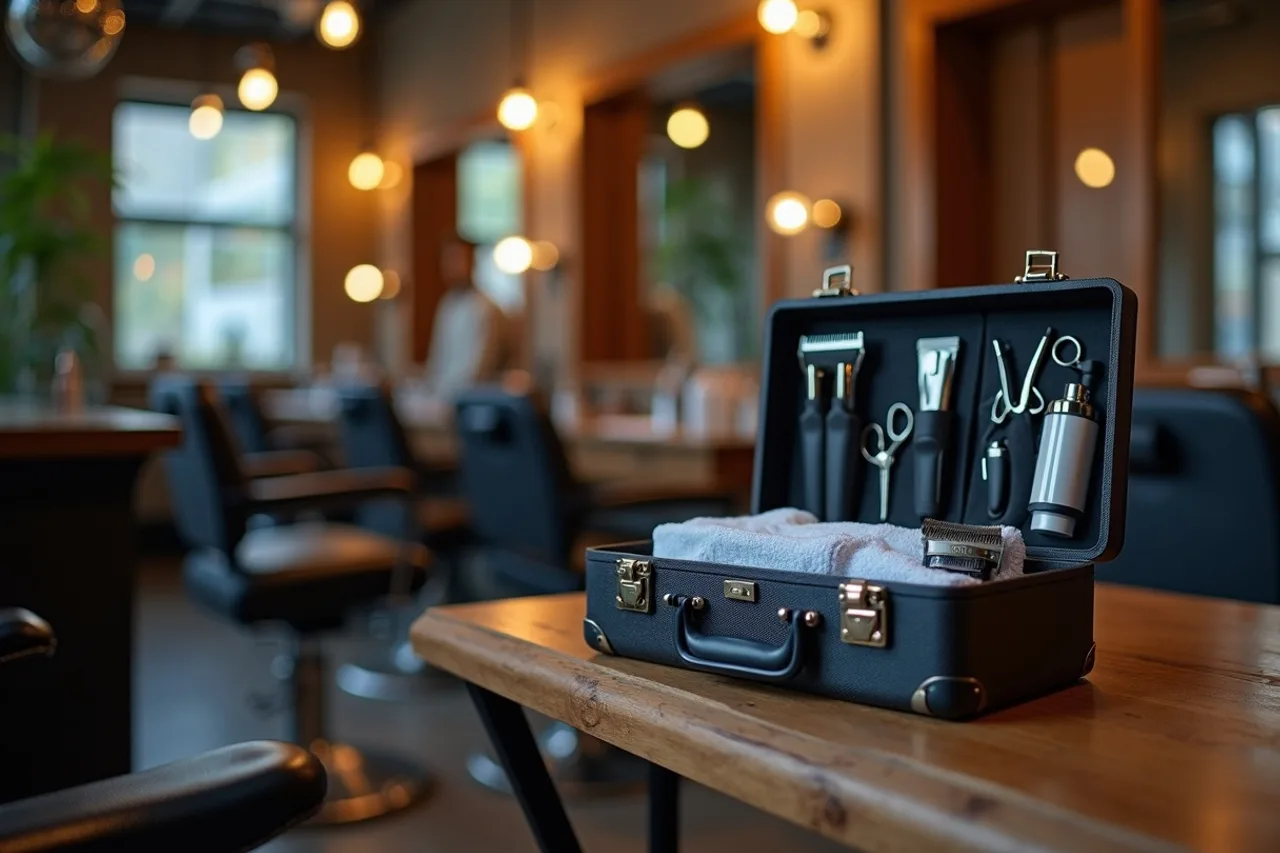
Your backpack / case is your mobile salon. If you didn't bring something, you don't have it at the client's.
| Item | What it's for |
|---|---|
| Hand disinfectant | When there's no access to a basin |
| Tool disinfectant + container | Disinfecting clippers between clients |
| Single-use blades, neck strips, towels | Zero transmission risk |
| Tools sterilised beforehand, in pouches | Ready, clean, marked with the date |
| First-aid kit | Handling a cut |
| Waste bag and used-blade container | Safe disposal |
We write more about sterilisation itself outside the salon in sterilisation in the field for a mobile barber.
How to set up the station at the client's
- Floor and surface — lay a single-use mat or a clean cover under the chair. You protect the client's home and have a clean zone.
- Clean zone and dirty zone — on one side the tools ready to use, on the other those to be disinfected. Don't mix them.
- Disinfection before and after — the work surface disinfected before laying out the tools and after finishing.
- You take the waste with you — used blades and single-use items don't stay at the client's.
A mobile barber's documentation
Having no premises doesn't exempt you from paperwork. Quite the opposite — without a fixed address it's worth having the documentation on you:
- The procedure for disinfecting and sterilising tools (who, with what, how often).
- Instructions on handling a cut to a client.
- Safety data sheets for the disinfectants used.
- Service terms and the client's GDPR consent (if you collect data or take photos).
GDPR and the client's rights in a mobile service
At the client's home you process their data: address, phone number, sometimes "before/after" photos. This is personal data.
- Collect only what is needed to arrange and carry out the service.
- For photos on social media you need separate, explicit consent.
- The client has the right to information about the price and scope of the service before it is performed — this applies to mobile services too.
Water and hand washing outside the salon
The weakest point of working in the field is hand hygiene. At the client's there isn't always soap, a clean towel, or even running water within reach. Plan for it in advance:
- Hand disinfectant — in case there's no access to a basin.
- Single-use towels — you don't dry your hands on the client's towel.
- Single-use gloves — for razor shaving and where there's a risk of contact with blood.
The rule is simple: since you don't have the salon's support base, you have to carry it in your backpack. No access to water at the client's doesn't exempt you from hygiene — being prepared does.
How to bill and document a mobile service
A mobile barber is a business like any other — with tax obligations and obligations towards the client:
- Receipt or invoice — the client has the right to a document confirming the service and the price.
- A clear price up front — travel, scope, any surcharges. The client learns the cost before the service, not after.
- The scope of the service in writing for larger jobs — especially when you go to a group (see a barber at events and weddings).
Insurance — why a mobile barber needs it more
Working at the client's, you're on their territory, with their furniture and floor. A flood, a stain, a cut — you're liable for the damage. Business liability insurance without premises is all the more important. More in the piece on liability insurance for a barbershop.
Common mistakes a mobile barber makes
Working in the field tempts you to cut corners on procedures — because "it's only a quick visit". The most common slip-ups:
- No preparation for multiple clients — a single set of tools for several people forces you to improvise.
- Drying your hands on the client's towel — instead of a single-use one. A small thing that ruins all your hygiene.
- Leaving waste at the client's — you take used blades and single-use items with you.
- No documents on you — the procedures, safety data sheets and service terms should travel with you, not sit at home.
How to build the client's trust in mobile hygiene
The client can't see your support base, so you show the hygiene on the spot. This builds trust and sets you apart from "a barber with a backpack and no rules":
- Unwrap the sterile tools in front of the client — they see they're new/clean.
- Fit a new blade and neck strip before their eyes.
- Disinfect your hands and the surface before you start.
Visible hygiene isn't only safety — it's a sales argument. A client who sees that you care comes back and recommends you.
Frequently asked questions
Does a mobile barber have to report the business to Sanepid?
You register a business with the appropriate PKD code. Sanepid may carry out an inspection of your business and check whether you ensure tool hygiene and safety procedures — regardless of the fact that you work at the client's rather than in a salon.
How do I disinfect tools without a salon's support base?
You take a disinfectant, a working container and tools sterilised beforehand in sealed pouches. Between clients you disinfect the clippers, and tools that have had contact with blood you swap for another sterile set — you do the sterilisation at your base, not at the client's.
Do I need the client's consent for "before/after" photos?
Yes, if you publish them on social media or in your portfolio. You need explicit, voluntary consent to use their image. The service itself does not entitle you to publish the client's photos.
What if I cut a client in their home?
You follow the same procedure as in the salon: stop the bleeding, dress the wound, disinfect the tool and the surface, record the incident. That is why the first-aid kit and the procedure must be in your mobile kit, and liability insurance covers any claims.
Working at the client's and want to have hygiene and paperwork always on you? BarberReady gives you a ready-made set for the mobile barber: disinfection and sterilisation procedures, a kit equipment list, instructions on handling a cut, service terms and GDPR consents. A salon without walls, but with a system.