Sanitary Training for a Barbershop Team
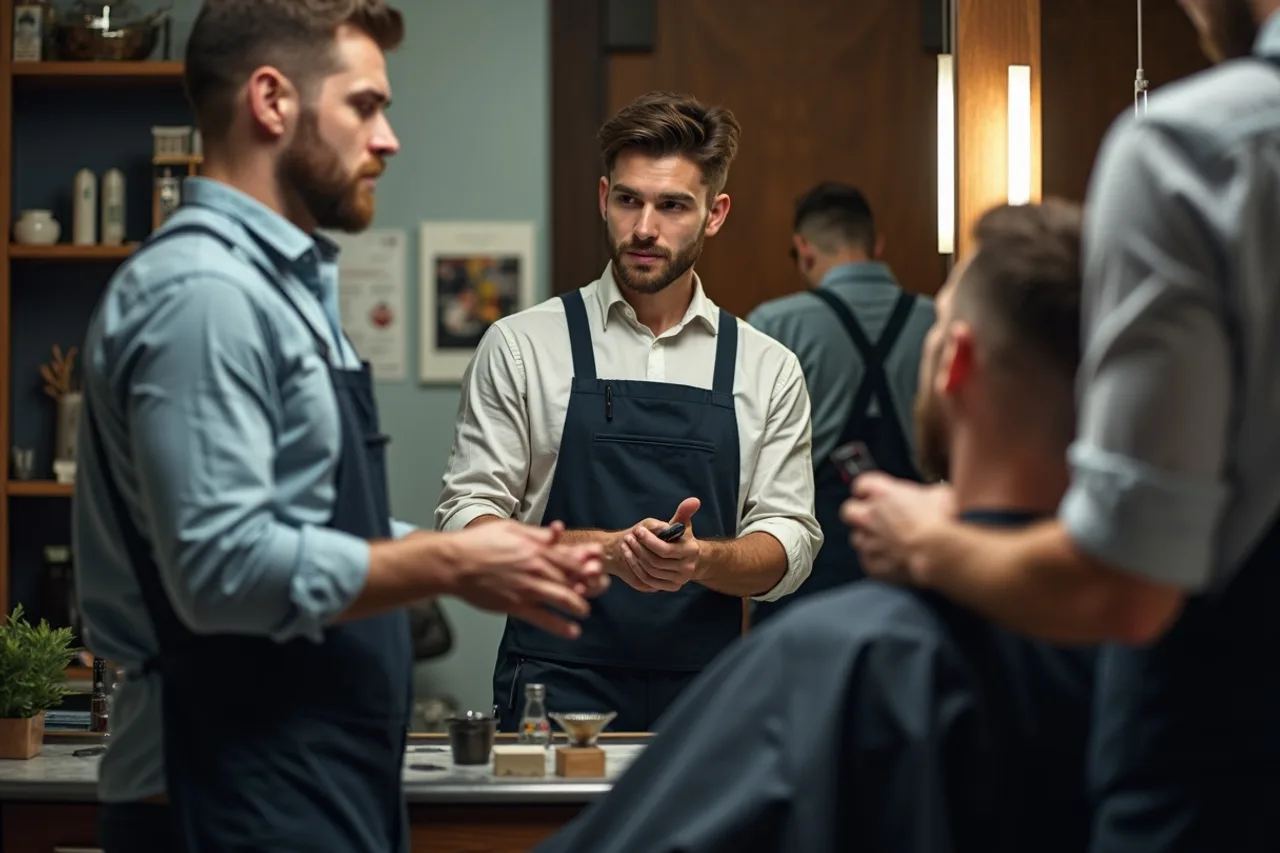
A Sanepid (sanitary inspectorate) inspector walks in on Friday afternoon, right in the middle of the rush.
A Sanepid (sanitary inspectorate) inspector walks in on Friday afternoon, right in the middle of the rush. He asks the nearest barber: "How do you disinfect the clippers between clients?" The barber looks at you. You look at the barber. Silence. This is the moment when it turns out you have procedures on paper, but not in your people's heads.
Sanitary-epidemiological training for the team is not "a sheet saying they've been trained". It is a shared language for the whole crew: everyone knows the same thing, does the same thing, and says the same thing when someone asks.
Why this training even matters
A barbershop means working with a blade against the skin, with the risk of a cut and contact with blood. Sanepid takes this seriously, because poor disinfection is a real risk of transmitting infections (hepatitis, staphylococcus).
Sanitary training is meant to give the team three things:
- Knowledge: what to disinfect and sterilise, with what, and when.
- Habit: so they do it automatically, not "when they remember".
- Proof: a signed document that everyone has completed the training and knows the rules.
Who has to be trained
Not only the barbers at the chairs. Everyone who has contact with the client or with tools:
- Barbers — the full scope: sterilisation, disinfection, handling a cut.
- Reception / front desk — hand hygiene, cleanliness of the shared space, communication with the client.
- Cleaning staff — products, concentrations, cleaning sequence, zones.
- New employees — before being allowed to work, not "when there's a free moment".
Scope of the training — what it must include
Good sanitary training for a barbershop covers specific, practical topics — not generalities about "keeping things clean".
| Block | What it covers |
|---|---|
| Hand hygiene | When to wash, when to disinfect, technique, after every client |
| Tool disinfection | Clippers, scissors, combs — product, contact time, frequency |
| Sterilisation | Autoclave, effectiveness monitoring, tools that come into contact with blood |
| Single-use items | Blades, neck strips, towels — when single-use is mandatory |
| Cutting a client | Step-by-step procedure, first-aid kit, recording the incident |
| Surfaces and the chair | Disinfecting the chair, counter and armrests between clients |
How often to repeat it
A one-off training session at the point of hiring is not enough. People forget, routine breeds complacency, and with staff turnover the knowledge drifts apart.
- Initial — for every new hire, before their first client.
- Periodic / refresher — at least once a year, short and practical.
- Ad hoc — after an incident (a cut, an inspector's remark, new equipment).
A short quarterly reminder (15 minutes at the briefing) works better than one big training session once every three years. If you have a mixed-language team, see our post on PL/EN instructions for a multilingual team.
Training documentation — what you show the inspector
Sanepid will not take your word for it. You need proof. The minimum set:
- Attendance list — first name, surname, date, topic, participant's signature.
- Scope of the training — a written record of the topics covered.
- Employee declaration — that they have read the procedures and undertake to follow them.
- Date of the next training — so it is clear this is a system, not a one-off episode.
The same applies to new people — we describe the step-by-step process in onboarding a barber in 7 days.
How to run the training so something actually sticks
An hour-long lecture after which everyone signs a list does not change behaviour at the chair. Sanitary training works when it is practical and short:
- Show, don't just tell — disinfect the clippers in front of the team, demonstrate the product's contact time, unwrap a sterile pouch.
- Practise on real situations — "a client has cut themselves, what do you do?" and have someone act out the procedure rather than recite it.
- One topic at a time — five short briefings beat one overwhelming training session.
- Check that it stuck — a week later, ask three questions. If the answers diverge, repeat the topic.
For onboarding new people, a ready checklist comes in handy — we describe it in onboarding a barber in 7 days.
Mini-test: is your training working?
Ask yourself these questions honestly:
- Would every barber give the same answer to a question about disinfecting the clippers?
- Does the team know which tools are single-use and which are sterilised?
- Does anyone on shift know where the first-aid kit is and how to record a cut?
- Do you have an attendance list from the last training?
- Does a new employee complete training before their first client, rather than "along the way"?
Three "nos" means you have training documentation but not a trained team. Those are two different things — and the inspector checks the second one.
The most common mistake: theatre instead of a system
"Sign that you've been trained" and job done. The sheet is there, the knowledge is not. The inspector asks the employee, not the sheet — and if the employee can't answer, all the documentation is worthless. Training is meant to change behaviour at the chair, not fill a binder.
Training and staff turnover
In barbershops people come and go — someone leaves to open their own place, someone new arrives. Without repeatable training, knowledge leaks out along with the people. That is why training has to be a process, not a one-off event:
- Every new hire goes through the same induction — not "someone will tell them along the way", but an established scope before their first client.
- The knowledge is written down — when an experienced barber leaves, the procedures stay in the premises, not in their head.
- Reminders for the permanent crew — short and quarterly, so routine doesn't breed complacency.
With a mixed-language team there is one more layer — the training has to be understandable for everyone. This is not an obstacle, just a condition for it to make any sense.
How long sanitary training really takes
Owners put off training because they picture an all-day course. In practice, well-designed sanitary training for a barbershop is:
- Initial for a new hire: 1–2 hours of practice plus observation over the first few shifts.
- Periodic refresher: 15–20 minutes at a briefing, once a quarter.
- Ad hoc after a change of equipment or product: a few minutes, but with a demonstration.
That is a small cost in time in exchange for a team that speaks with one voice during an inspection — and that genuinely protects clients.
Frequently asked questions
Is sanitary training in a barbershop required by law?
Hygiene and occupational safety are required. Barbers no longer have to hold the old "Sanepid health booklet" as they once did, but the employer must ensure health-and-safety training and knowledge of sanitary procedures. During an inspection, Sanepid checks the team's actual knowledge of the rules.
Who can deliver sanitary training for the team?
It can be delivered by the owner or a designated person familiar with the procedures, based on the premises' written instructions. Initial and periodic health-and-safety training is delivered by a person with the appropriate qualifications (e.g. a health-and-safety officer).
How often should sanitary training be repeated?
At least once a year as a refresher, plus initial training for every new employee and ad hoc training after an incident or a change of equipment. Short quarterly reminders work better than infrequent, long training sessions.
What if an employee doesn't speak Polish well?
The training and documentation must be in a language they understand. PL/EN instructions, pictograms and a translation of the key rules are not a whim, but a condition for the training to have value and to stand up in front of an inspector.
Want your whole team to speak with one voice during an inspection? BarberReady gives you a ready-made sanitary training programme: the topic scope, attendance lists, employee declarations, disinfection and sterilisation procedures, and instructions in a PL/EN version. A system, not theatre.