A Barber's Personal Protective Equipment (PPE)
A barber leans over the client, the razor glides across the cheek, fingers touch the skin - and here a question is born, one easily brushed off with a shrug: what…
A barber leans over the client, the razor glides across the cheek, fingers touch the skin - and here a question is born, one easily brushed off with a shrug: what protects you and your client in that moment? Gloves? The cape? A clean razor? A barber's personal protective equipment is not needless bureaucracy. It is the barrier between you and infection, between the client and chemicals, between a minor cut and a serious problem. This article explains what to use, when and why.
What personal protective equipment is
Personal protective equipment (PPE; in Poland: SOI, srodki ochrony indywidualnej) is equipment that protects a worker against hazards in the workplace. The obligation to provide it follows from the Labour Code - the employer supplies workers, free of charge, with personal protective equipment appropriate to the hazards at the station.
In a barbershop the hazards are specific: contact with blood, skin, chemicals and sharp tools. That is why a barber's PPE is matched precisely to those risks, not copied from another sector.
This is worth stressing, because protective equipment is sometimes treated as a whim or a hindrance. "Gloves get in the way of work", "the cape is a formality". Meanwhile it is these that stand between a minor cut and an infection, between contact with chemicals and skin irritation. A barber who takes care of protection works longer and more safely - and the client sees it and appreciates it.
Basic protective equipment in a barbershop
| Item | Protects against | When to use |
|---|---|---|
| Disposable gloves | Contact with blood, chemicals | Dyeing, contact with a wound, disinfection |
| Apron / work clothing | Soiling, chemicals | Throughout work |
| Client cape | Contact with hair, chemicals | Every service |
| Face mask | Dust, aerosols, droplet transmission | As needed, when working with chemicals |
| Hand-skin products | Irritation from frequent washing | Regularly, preventively |
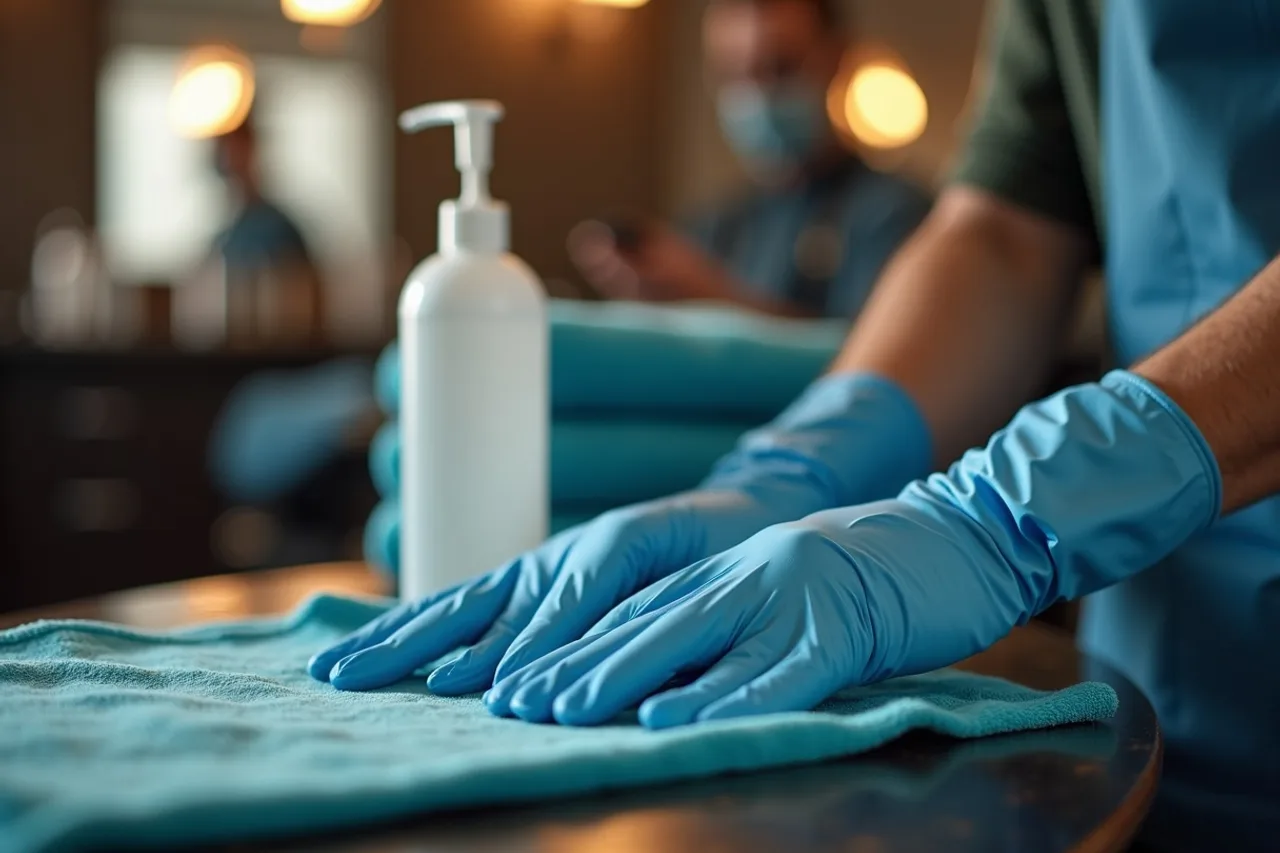
Disposable gloves are an absolute basic with every contact with blood and when dyeing. They are not only protection for your skin - they are also a hygiene barrier for the client.
Hand hygiene - the first protective measure
Before you reach for any equipment, hand hygiene is the most important thing. It is the simplest and most effective measure for reducing infections. The rule:
- Wash your hands before and after serving each client
- Disinfect your hands when there is no way to wash them
- Use a protective cream - frequent washing dries and irritates the skin
- If you cut your own hand - secure it with a dressing and a glove
A hand-washing basin must be available in the working zone - we write about it in the piece on premises requirements for a barbershop.
A well-organised station has a soap dispenser and a hand-disinfection agent within reach, so that hygiene does not require walking away from the chair every time. The fewer the barriers, the more often the reflex of washing and disinfecting is actually carried out. It is a small organisational detail that translates into the real level of hygiene in the premises.
Disinfection and sterilisation of tools
Protective equipment is not only what you wear. It is also the cleanliness of the tools that touch the client's skin. In a barbershop the rule applies: a tool after contact with skin or blood requires cleaning.
- Cleaning - removing dirt, hair, residues
- Disinfection - with a preparation of an appropriate spectrum of action
- Sterilisation - for tools that have contact with blood (autoclave, steriliser)
Razors with replaceable blades solve part of the problem - the blade is single-use and goes into the sharps waste container. But combs, scissors and clippers require regular disinfection. This is the first thing the inspector asks about - which we cover in the article on notifying Sanepid.
Choosing the right preparation is key. A tool-disinfecting agent must have an appropriate spectrum of action - it should be effective against bacteria, fungi and viruses. It is worth keeping in stock a preparation with a current authorisation and using it according to the manufacturer's instructions, especially regarding contact time. Spraying and immediately wiping is often not enough - the preparation needs time to work. Clipper heads are also worth cleaning of hair residue before disinfection.
Chemicals - dyes, liquids, sprays
A barber works with chemicals that can irritate the skin and respiratory tract. When dyeing a beard and doing intensive styling:
- Always disposable gloves when applying dye
- Good ventilation that removes fumes
- Product safety data sheets at hand
- Storing chemicals in a lockable cabinet, away from clients
A separate topic is clients' allergic reactions to dyes - we write about them in the piece on allergies in beard dyeing.
Work clothing and linen
Work clothing separates private clothes from work and protects against soiling. In a barbershop it is worth taking care of:
- An apron or dedicated work clothing, washed regularly
- Client capes - clean for each one, washed after soiling
- Towels - fresh for each client
- Separate storage of clean and dirty linen
Mixing clean and dirty linen is a classic sanitary non-compliance. One lockable bin for dirty towels and a separate shelf for clean ones is enough.
More and more barbershops are switching to disposable towels and covers, at least partly. It is a more expensive solution per item, but it eliminates the problem of washing and storage, while being hygienic and convenient. Whatever you choose, the rule is the same: each client gets a clean towel and a clean cape, and what has been used goes straight to the dirty zone.
The most common mistakes
- Gloves "only for dyeing", skipped when in contact with blood
- The same towel for several clients
- A razor with a reusable blade without sterilisation between clients
- Chemicals kept open on the worktop, within clients' reach
- A cape put on without prior cleaning
Each of these mistakes can be eliminated without great effort. Gloves and fresh towels are a cost, but a small one against the risk of infection or a complaint. It is worth treating protective equipment like fuel in a workshop - something that simply must not run out. A good practice is keeping a stock, so you are never faced with the dilemma "I have no clean cape, but the client is waiting".
Frequently asked questions
Does a barber have to use gloves?
Disposable gloves are essential with every contact with blood and when dyeing. They protect both the barber and the client and form a basic hygiene barrier.
How often should tools be disinfected?
Tools that have contact with skin or blood are disinfected after each client. Equipment that has had contact with blood additionally requires sterilisation, for example in an autoclave.
Does the employer have to provide barbers with protective equipment?
Yes. The employer supplies workers, free of charge, with personal protective equipment appropriate to the hazards at the station. In a barbershop these include, among others, gloves and work clothing.
Do disposable blades solve the sterilisation problem?
Partly. Replaceable, single-use blades go into the sharps waste container after use, so they do not require sterilisation. But combs, scissors and clippers still require regular disinfection.
Want your disinfection and protection procedures written down on paper?
BarberReady gives you ready-made procedures for hygiene, disinfection and the use of personal protective equipment - tailored to a barbershop. Exactly what the inspector asks about, without building it from scratch.